“I thought, if I’m getting so much from this beautiful thing, I want to share it. I want to help others. I want others to experience the magic of WCC, the way it can touch your life. So when I was invited to be a trainer, I understood it as an opportunity to give back at another level.”
– Shirin Tobie-Paul, WCC facilitator, Ottawa Chapter Lead
For the first time ever, we are thrilled to spotlight the group whose impact is felt in every WCC workshop: our Volunteer Facilitator Training Team.
Every year, WCC’s dedicated and experienced Training Team creates a thoughtful, supportive experience for new volunteers joining the organization. In celebration of Volunteer Month, we gathered for a conversation about the journey of training, why volunteerism matters, and what applicants can expect from an upcoming training event.
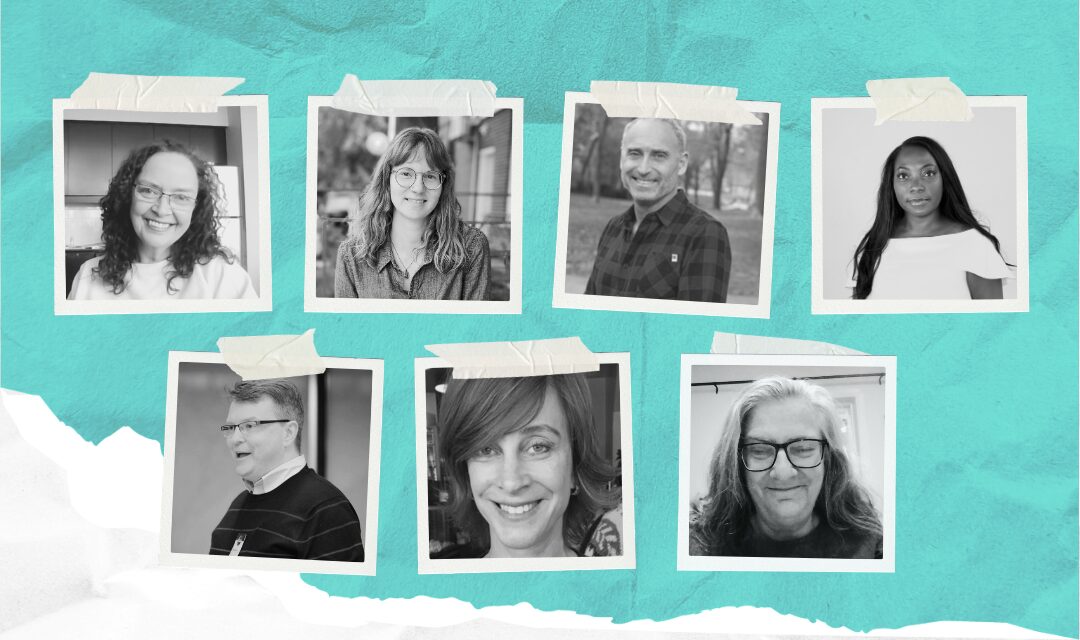 1st row L-R: Siobhan, Marijke, Doug, Shirin
2nd row L-R: Steve, Susan, Carmel
NIAMH (Manager of Communications): What first motivated you to volunteer with Writers Collective of Canada, and what inspired you to take on a role within the training team specifically?
STEVE (Peel Chapter Lead): Well, I’ll just jump in and say, for me, my first workshop experience was in a library, in Mississauga. I think it was pretty quick after attending a few workshops as a writer that I was already starting to look for further opportunities to contribute. So, that’s what got me into becoming a facilitator, sometime in 2019.
And it’s funny, leading up to this meeting, I started to think, what did propel me to be on the training team? I mean, certainly there’s a desire from me in terms of my background. I’ve often done different leadership and development training events, and I enjoy it.
So, I think it was likely somebody on the team asked, and I readily accepted, just because of the passion I had for the facilitation, and then the passion I had for training peers in other parts of my life.
CARMEL (Facilitator): I actually started out at a training session. I had not been to workshops before I went to the training weekend. I’d been looking for different ways to volunteer my time, and, you know, there were a lot of opportunities for teaching, which is part of my background. But I was also a writer. So I put “writing” into the search engine, as well as “teaching,” “volunteering,” and then Toronto Writers Collective, as it was named then, came up.
They were having a training event very soon, and I very last minute put in an application. I have no idea what I said, but, I got there. It was 2017. I went to the training weekend, that being my first experience with the workshops – with anything WCC – and it blew me away.
I mean, I was just really amazed at what people could write, in the limited time given, in front of each other. And then, you know, Siobhan and Doug were already trainers at the time, and they led us with deeply inspiring speeches. I still remember Doug’s to this day. The whole thing was very uplifting, supportive, and I was instantly hooked.
SIOBHAN (Director of Volunteers and Programs): I come from an arts background, and I wanted to volunteer somewhere that had not just arts, but a little bit of social service as well. I had a friend tell me about WCC, and when I checked out the website I thought, oh wow, because I’ve always loved writing, too.
My friend suggested I should be a facilitator, to at least check it out. So I went to the training, having never been to a workshop before, and the weekend blew me away. I remember Doug there, too, and I still remember the line in a piece I wrote that he reflected back to me. I would have never remembered what I’d written if not for that experience. Someone listening that closely, and affirming its strength. It was really powerful.
I thought it was all terrific, the warmth, the friendliness, and just the professionalism of the group of people I met that day, in 2015. When I started facilitating, I had Doug as my co-facilitator, so I learned a lot. I watched Doug as he slowly let me relax into it until I began to take the lead.
So, when I was asked to join the training team, I thought, this is just such an amazing opportunity. To be able to witness in a training weekend, participants go from, “I really can’t do this,” on the first day, to the end of the third day when they feel good, empowered, and confident in their abilities… It’s amazing. It’s cyclical.
SHIRIN (Ottawa Chapter Lead): I also found the WCC at a library, where I was looking for something just for me, while my children beat what’s-his-name at chess, once a week. And I went to the bulletin board, and I found a flyer for a writing workshop.
And I remembered, suddenly, oh yeah, I do love to write. And I actually wrote plays as a child. Anyway, it was a great way to get back into writing. I attended one workshop, and I fell in love. Eventually, a peer suggested I should be a facilitator. And I was like, no thank you, I’m hiding behind stories and healing my trauma.
But, then I thought, if I’m getting so much from this beautiful thing, I want to share it. I want to help others. I want others to experience the magic of WCC, the way it can touch your life. So when I was invited to be a trainer, I understood it as an opportunity to give back at another level.
DOUG (Executive Director): It was early in WCC’s history when there was an opportunity for me to get trained as a facilitator. Just like Siobhan and Carmel, I hadn’t been in a workshop before. I went straight into training. There weren’t many workshops then, anyway.
But I joined because I didn’t come from a background of a lot of ability to give. We were a lower-middle class family, with a single parent, and we didn’t grow up having the means to be philanthropic. And it always really bothered me. And then there was this opportunity to do something community-based. To do something worthwhile. And it seemed like that’s how I could do something. I could give my time.
That’s how it started for me. None of us here have ever looked back because, you know, we always wonder: who gets more out of this? Our facilitators, our writers, our partners? It’s just a win-win-win. And ultimately the communities we serve win, too. So it’s a four-way win. A win-win-win-win.
MARIJKE (Manager of Volunteers and Programs): I believe I attended the final in-person facilitator training before the pandemic hit. It was in the fall of 2019. I joined a training offered for staff and volunteers involved with Metro Toronto Movement for Literacy (MTML). At the time I had been volunteering at the West Neighbourhood House, running a creative writing drop-in class for adult literacy learners.
And so I had heard of WCC (a partner of MTML) before, and was really interested to learn more. The staff encouraged me to take the training and I remember it feeling just completely up my alley, in terms of facilitating and facilitation practice. And just the idea of sharing stories, listening to one another. That was really wonderful.
And, on the third day, I had a whole lot of fun being a disruptor. Someone else in my group didn’t want to volunteer, to disrupt and say something negative, or use profanity. And I was like, oh! I like profanity! I’ll disrupt.
NIAMH: That’s so funny. Is that part of the role-playing during training weekend?
MARIJKE: Oh, yes! Everyone takes turns practicing facilitating for a small group. And on the second day, we introduce different kinds of conflicts that may come up. Other people in the group are asked to disrupt the workshop in some way.
NIAMH: Thank you for that context, that sounds like a very useful – and fun – exercise! Elaborating on some of the qualities you folks have already shared, can you tell me what makes WCC’s volunteer training experience unique?
CARMEL: The aim is to give people confidence in their existing strengths—to reinforce those existing strengths and bring them out. It’s identical to the way that we facilitate workshops, where we talk about what’s strong in the writing, that’s how we approach the training.
SIOBHAN: The element of surprise! There are often moments of surprise during the training weekend.
I mean, what other training can you take where there’s laughter and tears? And real community building? We’re training community builders—that’s what our facilitators are—but, also, a community is being built within every training. Each cohort gets to know each other a bit. They can rely on each other, and on us.
STEVE: No two trainings are the same. And I would say that’s from two angles. First, I’m amazed at the diversity of facilitator trainees, and the life experiences that they bring. And secondly, it’s this team. As a team, we’re never satisfied—the script never stays the same.
With every training, Siobhan leads a discussion during which we figure out what’s working, what isn’t, and how to apply feedback. We’re always striving to get it better. We never rest on our laurels. While the structure might function the same, we take what we’ve learned as a group and we continue to make changes, to keep it fresh for ourselves.
SHIRIN: It’s a very humbling space. You know, you’re training alongside the Executive Director, the Founder, the Director of Volunteers. And still you feel comfortable, confident, supported, and connected.
CARMEL: Just to add to that, I mean, watching Susan during training events, I find it inspiring every single time. I’ve been doing these trainings for several years now, and she just has an amazing gift, of listening and reflecting, that she continues to work at. When I watch her and listen to her facilitate the training workshop, I’m taking notes, I’m thinking: “I’ve never done that before, but, I could do that.” It helps me learn every time.
SIOBHAN: I want to echo what these two are saying. Having Susan there over the weekend is so significant. She made the organization. She has the words. I always find her presence very inspiring, having the founder’s voice in the room. It personally inspires me not only as a trainer, but as a workshop facilitator, too.
MARIJKE: As a staff member, I really feel that the WCC team does its best to walk the walk. We don’t want to just talk the talk, we want to walk the walk. We learn from the people who are training us. We take their feedback seriously and integrate it the best we can. So the training experience is shaped by those who attend it.
It’s inspiring to me how much of a commitment it is. You know, it’s a full weekend. It’s invigorating to be in the room with these prospective volunteers who are excited and eager to be a part of the organization. And that always makes me come away from the training event feeling inspired by the community that we support, more than ever.
NIAMH: Thank you all for sharing what makes WCC’s training special. How does this experience of leadership and facilitation of training show up in other areas of your life, personally/professionally?
SIOBHAN: I believe I have become more direct and boundaried. In training, we’re balancing being trainers with presenting a non-hierarchal model. We don’t want to be overly prescriptive, because it’s an environment of peers. But I’ve found WCC’s Six Essential Practices have, over time, naturally guided me to be more intentional.
DOUG: For me, it’s how I’ve been touched by the people. There are so many different walks of life, diverse backgrounds of those we meet in a training. We’re witnesses to great writing. To courage. To community. We experience community in a very, very authentic way.
And you can’t help being not only touched by the experience, but I’ve been changed by it. My sense of appreciation, understanding, and insight into what society is all about is way more clear. And when I walk by people, see and hear people, my rush to judgment, or assumption, is way slower.
Having been a part of, and being part of WCC, I’m much more aware of the possibilities out there. And the different realities out there. WCC has really impacted just my complete perception of our world.
SIOBHAN: And you see this with the trainees, too. People expand their perspectives and horizons, they find common threads between themselves. You’ll see two people who are vastly different from each other, but when they read and listen together, it’s amazing to witness. They discover their shared humanity. There’s a light shone on it, you know.
NIAMH: For someone considering facilitator training, what would you want them to know before they take that first step?
SIOBHAN: That they’re not alone. They won’t be alone.
STEVE: That’s really nice, Siobhan. That says it. I don’t know that I can even add to that, because, wow. That’s it.
CARMEL: I want to add that it’s going to be a joyous experience.
SIOBHAN: Joyous and enriching. And very often, life-changing.
SHIRIN: Ha! I mean, I can be the poster child for that… it’s definitely life-changing. But, really, Siobhan got it the first time. You’re not alone. You have your co-facilitators. You have your training team. We’re here. There’s always a friend here.
SIOBHAN: Yes! And we’re collaborative. We’ll work with you, with your schedule, with your needs. If you’re thinking of becoming a facilitator, we’ll do our best to make it happen.
We extend our deepest thanks to the Training Team for an illuminating conversation about the love and labour that brings to life every WCC workshop. We wish you and all our volunteer facilitators a very happy Volunteer Month!