“Just as Zoom has enabled people who cannot easily leave their homes to connect, online facilitation opens us up to stories we might not otherwise hear.” – David Lightfoot, WCC Facilitator
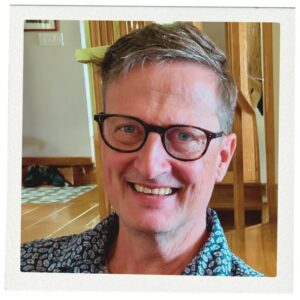
This month, we are proud to spotlight David Lightfoot, a long-time WCC facilitator with experience leading both on-site and virtual workshops. We asked David about his journey as a volunteer with WCC, and his transition from on-site to virtual facilitation after moving.
Describe your journey as a WCC facilitator – how did you find WCC, and when did you become a facilitator?
DAVID: I’m not quite sure why I joined WCC, but I am quite sure I didn’t appreciate the process or its value until I had spent some time working with other facilitators and WCC writers. While WCC is a wonderful place to learn to write, writing with others also fosters creativity and self-care. Ten or so years later, I remain committed to the process. It sparks my creativity and reminds me that people are so much more creative and interesting than they first seem. Listening to people’s stories always leaves me with something new: a turn of phrase, an image, or a fresh perspective.
 What do you experience in a WCC workshop, when you write in community?
DAVID: There is a kind of magic to prompts. The necessity of focusing on one topic, with just a tiny nudge, makes storytelling easier. The strict time limits also quiet our monkey minds. We so often hear, “I write, but I never finish anything.” Yet far more difficult than finishing is discovering the story you want to tell—the story you need to tell. This is where WCC truly shines. I see the very act of writing centre people and bring them out of themselves. I walk out of every writing session feeling elated, and I believe I am far from alone.
Tell us about one of WCC’s Six Essential Practices and how you see it come to life in your workshops.
DAVID: I like to joke that “it’s not all about YOU”—we’re talking about the piece here! Quite simply, the most important practice is treating every piece of writing as fiction, even if it is labelled autobiography.
I know it can seem cold not to reach out to people when emotions are running high, but this practice is emancipatory. We can try out ideas without having to justify them, and voice thoughts that we need to explore. It breaks the loops in our minds and helps us understand what we are really thinking.
Years ago, in an academic creative nonfiction class, a straight man began writing about his experiences as a burlesque performer at a gay nightclub. It was meant to be a comic piece, but it became obvious that he had some unresolved feelings. I remember watching and realizing that he wasn’t getting what he needed. He didn’t need to answer questions about what happened or why. He needed a place to explore the story he needed to tell. He didn’t need pity. He didn’t need support. He needed to write and hear his own story reflected back through the responses of others. As a writer, it’s amazing to hear how people perceive your story. As a human being, it can be deeply therapeutic to hear your own story through the feedback of others.
Almost every long-term participant finds that writing together becomes a journey of self- discovery. People work through their ideas faster on paper than in their heads, and more clearly when sharing them with others. Having an audience compels us to flesh things out more fully.
Virtual programming has allowed facilitators to stay involved even when they move, travel, or live far from workshop locations. What motivated you to bring WCC with you? How has the flexibility of virtual programming strengthened WCC’s facilitator community?
DAVID: I recently moved from Toronto to the countryside, to a place with few public spaces where people are geographically isolated. Transportation requires a significant investment of both time and money. WCC has eased my own transition to this new way of life, though I do hope to start in-person workshops here as well.
Just as Zoom has enabled people who cannot easily leave their homes to connect, online facilitation opens us up to stories we might not otherwise hear. It’s important to acknowledge, too, that those of us who love writing in groups may forget how intimidating these settings can be at first. Virtual workshops can feel more accessible and less intimidating, making it easier for people to take that first step.
Why do YOU write?
DAVID: I do enjoy writing on my own, but writing with others is something different. It’s a form of mutual self-care: people listening to one another and sharing their stories. People leave a writing session more relaxed and feeling better. Each story, it seems to me, is a gift.
Thank you, David, for your inspiring work as a dedicated WCC facilitator and community builder, and for bringing us with you over the years.