“It is simply about showing up and sharing your story. Our workshops are purely an invitation to become a part of our writing community, to find a place of belonging, no matter who you are.”
– Nadja Lubiw-Hazard, WCC Facilitator
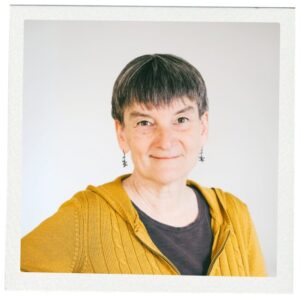
Meet Nadja, a WCC facilitator since 2020. For this month’s spotlight, we spoke with Nadja about being a long-time facilitator, and what 2SLGBTQ+ pride means to her.
Q: Describe your journey as a WCC facilitator – how did you find WCC, and when did you become a facilitator?
NADJA: I am always looking for new ways to learn more about the craft of creative writing and to connect with the writing community, so WCC seemed liked an ideal place for me to volunteer. I had a lovely weekend training in-person back in Feb 2020, right before the pandemic. I only got the chance to do one workshop in person, at Sistering in Toronto, before everything shut down. I eventually trained for online workshops, and spent four years cofacilitating every Friday afternoon. It was an unforgettable experience. Now I’m looking forward to facilitating in person this summer!
Q: What do you experience in a WCC workshop, when you write in community?
NADJA: The experience of a WCC workshop is always something special. I love preparing for the workshop, choosing a poem or a quote that I think will resonate with participants and lead to rich responses. Hearing everyone’s fresh, first-draft writing feels like a gift to me. It reminds me of Rumi’s poem, The Guest House: “This being human is a guest house./Every morning a new arrival.” So many things appear during a workshop – joy, depression, love, grief, trauma, healing. And a great tenderness in the way other writers respond with respect when someone reads their work aloud.
Q: Tell us about one of WCC’s Six Essential Practices and how you see it come to life in your workshops.
NADJA: “The workshop facilitator writes and reads too, taking the same risks as everyone else.” This is one of my favourite essential practices. For me, it really removes the sense of hierarchy that is present in a traditional writing class and makes me feel more connected to the group.
Q: June is Pride Month! What does Pride mean to you as a facilitator, writer, and human being?
NADJA: Celebrating Pride Month is all about embracing my authentic self, about embracing love and not hate. For me, pride is the real antidote to its shadow, shame. Homophobia is hurtful, hateful, and damaging; it leads to people being mistreated and stigmatized, to people hiding who they are because of fear and shame.
It breaks my heart to know that 2SLGBTQ+ youth are four times more likely to attempt suicide than their peers. Pride is standing up for those who lead the revolution, and to those who still need the revolution. It’s a revolution of love and acceptance.
Q: How can writing and storytelling support 2SLGBTQ+ visibility, connection, and joy?
NADJA: In WCC workshops, there are always those moments when a writer shares, and there is a spark of recognition from the group. Whether it is related to a story about being bullied or abused, about being left out, or about being made to feel ‘other’, there is this response that says, in so many different ways, “I’m with you, I’ve felt that way too.” That can be so validating. And to read or hear a story that doesn’t just share an identity, but celebrates it, is so life-affirming.
Q: What is the significance of facilitating braver, accessible spaces for any writer to simply show up and be themselves?
NADJA: One of the best things about the space we try to create in a WCC workshop is that no writing experience is required, and there is never a focus on improving the writing or critiquing the writing. It is simply about showing up and sharing your story. Our workshops are purely an invitation to become a part of our writing community, to find a place of belonging, no matter who you are.
Q: Why do YOU write? Tell us about your relationship to writing!
NADJA: When I write, I often find myself in a flow state, where I am completely immersed; I lose my sense of self and my sense of time. I love that feeling. I imagine the writing is flowing through me, not coming from inside me. I also write because I find it is a profound place of healing for me. I often write about difficult subjects – about mental illness, grief, violence, trauma – and as I do, I feel like I am releasing some of my most difficult experiences and emotions, and that I am alchemizing the harm into healing.
Thank you, Nadja, for your gifts of time and talent as a WCC facilitator and community member.